


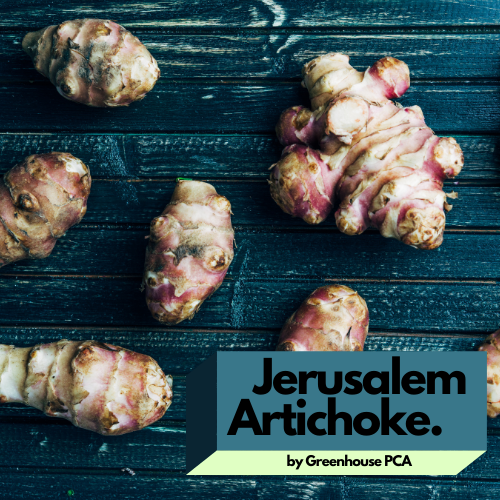
Sunchoke Tubers (Helianthus tuberosus) — Live Jerusalem Artichoke Tubers for Planting

Plant them once. Dig them every fall for the rest of your life.
Most vegetables you plant every spring. These you plant once.
Jerusalem artichokes, or sunchokes, are a perennial root vegetable in the sunflower family. They're native to North America and were being grown here long before anybody brought a potato over. They come up six or seven feet tall, flower yellow in late summer, and set a crop of tubers underground that you dig after the first frost.
Then they do it again next year. And the year after that.
You don't replant them. There's no seed to save and no germination rate to worry about. And you don't need somewhere to store the harvest, because the ground is the root cellar. Leave them where they are through winter and dig what you need when you need it.
That last part is why a lot of the people buying these from us are putting in a food supply rather than a garden bed. There isn't another crop that asks this little and keeps producing this reliably.
Why buy them from us
A customer wrote to us recently and signed off with this:
"so u are king of the jerusalem artichoke world, cause when i google, google highly recommend u."
We'll take it. This is our crop and we've put the work in.
What actually matters to you is that we know how to ship them.
Sunchokes are extremely tough once they're in the ground and extremely delicate out of it. Here's the part almost nobody gets right: they don't need to breathe. Air is what kills them. A tuber sitting out in the open dries down and loses viability faster than just about anything else you can order in the mail. That's why people so often get a bag of shriveled sunchokes from some marketplace seller and figure they got a bad batch.
We pack ours in sealed bags with a pinhole or two, the same day they ship, so they show up carrying the moisture they left with. They come nested in cedar chips with a growing guide in the box.
What you get
- 3 tubers, $11.00
- 5 tubers, $15.00
- 25 tubers, $34.00
- 1 pound, $26.00
- 2.5 pounds, $33.10
- 5 pounds, $48.25
- 10 pounds, $94.00
- 20 pounds, $188.00
Three tubers works out to $3.67 each. Twenty-five brings it down to $1.36. If you're starting a patch you intend to keep, the bigger counts are where the value is, and a patch started from 25 tubers gets to feeding you a year sooner than one started from three.
When to plant
A customer wrote in and asked us this:
"is that true that u can plant jerusalem artichoke tuber any time of the year, you can leave them outside overwinter and they will come back next year."
Mostly yes. Here's the detail.
Spring is the easy answer. Get them in once the ground can be worked and they'll be up in one to three weeks.
But you have more room than most people think.
Late summer is not too late to plant, it's just too late for a real harvest that year. They'll grow slowly in the heat, which is fine as long as you keep water on them, and they'll put down a few small tubers before the first frost. Leave those in the ground over winter. Every one of them comes up the following spring, and then you're on the normal cycle.
Winter planting works too. Nothing happens above ground, which unnerves people, but the tubers sit there and sprout when spring arrives.
Plant them four to six inches deep, a foot or two apart, in full sun to partial sun. They aren't fussy about soil. They want water more than they want anything else.
We wrote the whole thing up step by step here: How to Plant Your Sunchoke Starts. It's the same guide that comes in the box.
Will they take over?
Sort of, and whether that's a problem depends on what you're after.
If you put them somewhere they like, leave them alone, and give them enough water, the patch will get bigger every year, and not by a little. One plant makes a lot of tubers, and every tuber you don't dig comes back as next year's plant. It compounds.
For scale: they're nowhere near running bamboo. Not quite as pushy as mint planted straight in the ground. But they will spread if you don't harvest them each year.
For a lot of the people who buy these, that's the entire point. If you want a patch that feeds you, or a standing emergency food supply you never have to replant, spreading is the feature. Plant it once and it's there.
If you'd rather they stayed put, use a raised bed or pots. They won't climb out of a raised bed. They're not that crazy.
And pots don't cost you much in yield. I've seen them pack so many tubers into a 5-gallon bucket that they split the bucket down the side.
Harvest and storage
Dig them after the first frost knocks the tops down. The flavor is better after a frost.
Then leave the rest in the ground. That's genuinely the best place for them. Sunchokes don't keep well once they're out, and the fridge isn't reliable past about two weeks. Dig what you're going to eat this week and let the ground hold the rest.
A lot of growers think the ones that overwinter in the ground taste better the next year. I'd agree with that.
If you do need to pull a batch and keep it, here's how we handle it: How To Store Your Sunchokes For Winter.
A note on the gas thing
You may have heard that sunchokes give people gas. Some people affectionately call them fartichokes.
Some people do report it, so the first time you eat them, start with a small amount and see how you do. Sunchokes store their energy as inulin instead of starch, and your gut handles inulin differently. That's all it is.
Most of the people who have trouble with it are eating them raw. Cooking takes most of it away, so if you're worried, cook them the first few times and go from there.
A customer called me about exactly this. They loved the raw crunch and didn't want to give it up, so they pickled a batch instead. The fermentation solved it completely.
Tubers that have been through a frost or sat in cold storage a while also tend to be sweeter and easier on people. That's part of why a lot of growers leave them in the ground over the winter.
Common questions
Are sunchokes invasive?
They spread, but they're controllable. Less aggressive than mint in the ground, nowhere near running bamboo. Harvest each year and the patch stays where you put it. Plant in a raised bed or pots if you want them fully contained.
Do I have to replant every year?
No. Any tuber left in the ground comes up the following spring. Plant once and the patch is self-renewing.
Can I plant them in summer?
Yes, but you won't get a real harvest that year. They'll put down small tubers before frost, and those come up the next spring.
How do I store them?
In the ground. They don't hold well once dug, and about two weeks is the limit in the fridge. Dig what you'll eat.
Can I eat them raw?
Yes, and they're crisp and nutty. Just start small, since raw is where most people notice the gas.
Will they grow in a container?
Very well. A 5-gallon bucket or a half barrel produces a real crop and keeps them contained.
Plant facts
- Botanical name: Helianthus tuberosus
- Also known as: sunchoke, sunroot, wild sunflower, earth apple
- Form: Tuber
- Mature height: 6 to 7 feet
- Sunlight: Full sun to partial sun
- Water: High. Water is the main thing they want
- Planting depth: 4 to 6 inches, 12 to 24 inches apart
- Sprouting: 1 to 3 weeks in workable soil
- Hardiness: Perennial, and tubers overwinter in the ground in most of the country
- Harvest: After the first frost, and through winter as needed
- Edible parts: Tubers, raw or cooked
- Ships with: Cedar chips and a growing guide
Our guarantee
If anything's wrong with your order, call or text me at (760) 835-8711 and I'll replace it or refund it, whichever you'd rather. No time limit and nothing to mail back. That's my personal line and I answer it myself.
Free shipping.